Wisdom Wednesday
Whose Work Gets Someone Else's Name On It
Part 4 of 5 · The Reformation Series
September 23, 2026

Christopher McCormick, Founder & CEO, Visionary Consulting
The Reformation | Week 4 of 5 | Wisdom Wednesday
You already know this scene. A woman is walking down the sidewalk with her purse over her shoulder. A kid runs past, grabs the strap, and keeps running. She screams. Somebody nearby takes off after him, maybe catches him, maybe doesn't. Either way, nobody watching that scene needs it explained to them. The kid is the thief. The purse was never his. Whatever happens next, chase or no chase, recovered or gone, the moral accounting is instant and universal.
That scene runs, in some version, inside almost every company, almost every day. The difference is that nobody chases the kid. The kid, in this version, has a bigger title, a seat at a table the woman doesn't have access to, and enough standing that when he says the purse was always his, people believe him faster than they believe her. Nobody sprints down the hallway after him. Instead, the room nods along, decides the purse suits him fine, and quietly wonders what the woman was doing carrying something that nice in the first place.
Inez had built the churn-prediction framework over six weeks, mostly on her own time, because the account had gone quiet and she wanted an answer before her director asked for one. She walked Grant through it in a working session on a Tuesday. He asked good questions. He said, more than once, that this was exactly the kind of thinking the team needed more of.
Two weeks later, a colleague on the executive-review team forwarded her a deck. Slide fourteen had her framework on it, cleaned up, rebranded, and captioned "an approach I've been developing with the team." Her name did not appear anywhere in the file. Grant had presented it to the executive committee that morning as his own thinking. Nobody in that room had any reason to think otherwise, because nobody in that room had been in the working session two weeks earlier.
Inez did not resign over it. She stopped bringing her best thinking to Tuesday working sessions with Grant. She started keeping a private folder of dated drafts nobody asked her to keep. Both of those are rational responses to what just happened to her, and both of them are also exactly what an organization loses when this pattern runs unchecked long enough: the people worth listening to stop showing their work out loud.
The theft that never gets named as theft

Call it what it is. Organizational behavior researchers call it knowledge theft, and it turns out to be closer to normal than exceptional. Professor David Zweig at the University of Toronto Scarborough and the Rotman School of Management ran a series of studies across more than 1,500 workers in the United States, the United Kingdom, and Canada, and found that in one of them, 91 percent of participants reported either being a victim of knowledge theft, being the person who did it, or watching it happen to someone else. A separate, frequently cited OfficeTeam survey put the share of employees who say they have personally had an idea taken from them at roughly 44 percent. Different methodologies, same order of magnitude: this is not a rare betrayal. It is closer to background weather in most organizations, which is exactly why almost nobody has a policy for it.
Nobody built a fraud unit for this the way organizations do for financial misstatement. There is no regulator who shows up when a director drops an analyst's name from a slide. The damage doesn't trip an alarm. It just quietly teaches the most capable people in the building to stop volunteering what they know, one Tuesday working session at a time.
Here's a question worth sitting with before your next leadership offsite: if you mapped every idea presented at your last three executive reviews back to the person who actually originated it, how many names would move?
The territory version of the same instinct
The Reckoning's closing piece named a pattern that runs at the organizational level rather than the individual one: the executive who uses a reorg to route more teams and a bigger budget through themselves, and calls the result efficiency. Headcount consolidates upward. The person proposing the restructuring becomes the person who is harder to remove, not easier. The story told in the town hall is about streamlining. The story that actually happened is about territory.
Credit theft is that same instinct, scaled down to the size of a single meeting. An executive who expands their footprint through a reorg and a director who drops a name off a slide are running the identical calculation: whose story does this outcome tell, and can I make it tell mine. One version shows up in an org chart. The other shows up in a deck. Neither one requires malice, exactly. It only requires that nobody in the room is positioned to correct the record, and that the person doing the correcting would have to spend social capital they don't yet have to do it.
Why do you think the organizational version of this pattern gets audited, at least occasionally, while the individual version almost never does?
The photograph that told two different stories

In May 1952, a chemist and X-ray crystallographer named Rosalind Franklin, working at King's College London, captured an image of DNA fibers that came to be known as Photograph 51. It remains one of the most important photographs in the history of science. It took her the better part of a year to fully analyze what it showed.
In January 1953, a colleague of Franklin's, Maurice Wilkins, showed that photograph to James Watson, without asking Franklin first. Watson would later describe the moment as immediately clarifying, the instant he understood DNA had to be a double helix. Two months later, Watson and Crick published their model in Nature. Franklin's own data, gathered independently, was published in the same issue, in a separate paper, positioned as supporting evidence for a conclusion that her own photograph had done more than support.
Franklin died of ovarian cancer in 1958. In 1962, Watson, Crick, and Wilkins received the Nobel Prize for the discovery. Nobel rules at the time did not allow posthumous awards, so there was never a mechanism by which Franklin could have shared it even if the committee had wanted to include her. Historians still debate exactly how deliberate the omission was. Some argue Wilkins and Franklin's data was never formally confidential and that Watson and Crick did not, in the strict sense, steal anything. What is not in serious dispute is the outcome: the person whose photograph made the discovery possible was not in the room when the story of the discovery got told, and by the time anyone was in a position to correct that, she was not in any room at all.
That is the sharpest version of Grant's slide fourteen that history has to offer. The mechanics scale down perfectly. Someone does the work that makes the breakthrough possible. Someone else is the one standing at the podium when the breakthrough gets named. The gap between those two people is where credit theft actually lives, and it rarely requires the second person to have done anything a courtroom would recognize as wrongdoing.
Have you ever gone back and checked who actually built the thing your organization now tells as one person's story?
The category she was never allowed to leave
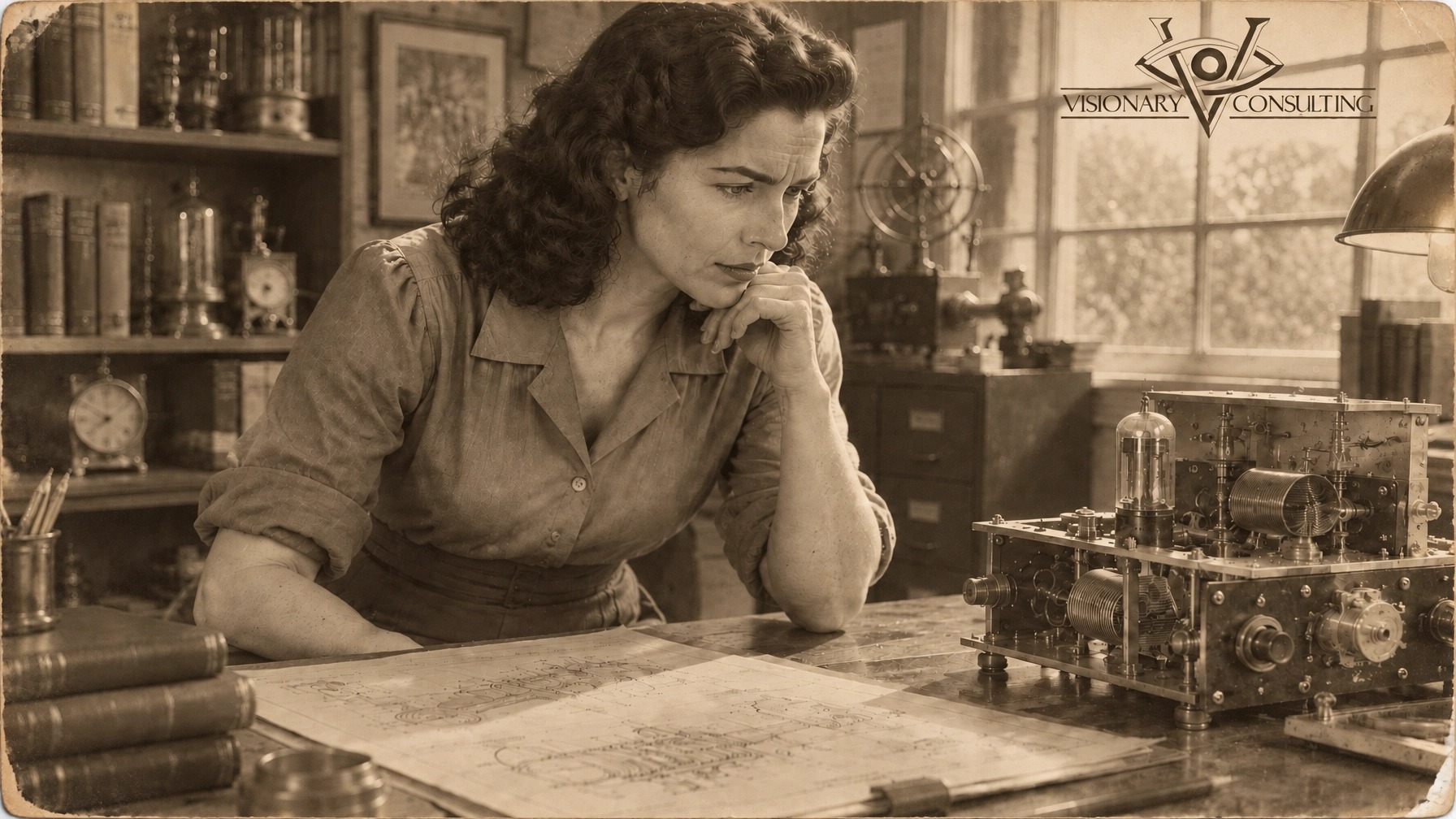
The Revolutionary Leadership Series' piece on Hedy Lamarr described a related but distinct failure. Lamarr and the composer George Antheil co-invented frequency-hopping spread spectrum technology, the foundation underneath what became WiFi, Bluetooth, and GPS, and filed the patent on June 10, 1941. The Navy examined it, decided it was too complex to implement, and suggested Lamarr would be more useful selling war bonds. She raised the equivalent of roughly $450 million in a single evening doing exactly that. The patent expired in 1959, before the Navy declassified the technology and began deploying it in the early 1960s.
Franklin's case is about a specific decision made in a specific month: who got shown a photograph, and who didn't. Lamarr's case is about something slower and more structural: an institution that had already decided, before she ever filed a patent, which category she belonged to. Actress. Beautiful. Not an inventor, because inventor was not a category the Navy had any mental space left to put her in, no matter what the patent said.
Grant did not have to decide, in any conscious way, that Inez wasn't the kind of person who presents to the executive committee. The organization had likely already decided that for him, the first time it built a review structure where only directors and above get a seat at that table. By the time Grant walked into the room with slide fourteen, the category had already done most of the work. He just filled in the slide.
Where in your organization has the category already been decided, long before anyone in the room today made an individual choice about it?
What actually protects the record

None of this gets fixed by asking people to be more honest, the same way none of the first three weeks of this series got fixed by asking leaders to care more. Caring was never the missing ingredient. Structure was.
The organizations that don't have this problem, or have less of it, tend to share one unglamorous habit: they make authorship visible by default, before the moment credit becomes contested, not after. Working documents carry a name and a date at the top, and nobody removes them on the way to the next deck. The person who did the analysis is in the room when it gets presented, or their name is on the first slide whether they're in the room or not. None of that requires a policy binder. It requires deciding, in advance, that the record is worth more than the convenience of a clean narrative with one author.
Franklin's data was published under her own name, in the same issue, and it still did not protect her, because visibility without power in the room is not the same as credit. The habit that actually holds up is naming the source at the moment the idea is first used, not waiting to see whether anyone asks.
This week's audit is different from the first three. Pull the last five ideas that moved a real decision in your organization, the ones that changed a strategy, a launch, a hire. For each one, write down who originated it and who presented it. If those are consistently different people, and the first name never appears anywhere in the room where the decision actually got made, you don't have a values problem. You have a habit of letting the wrong name become the permanent record, one slide at a time.
Next week, this series turns to the hardest version of everything it has named so far: what actually happens when the person who needs to change the pattern is the person with enough power that nobody feels able to make them. A reformed dashboard, an honest succession bench, and a slide with the right name on it all still run into the same wall if the person violating them can't actually be told no.
Inez is still at the company. She has not said anything to Grant. That is not cowardice. It is a completely rational read of what happens to people who correct the record out loud against someone with more power in the room than they have. So ask it directly, and don't let yourself off with a vague answer: If Inez spoke up right now, would your organization prove her wrong?
Where Vision Meets Reality.
The The Reformation Series
A five-part series on rebuilding the systems The Reckoning exposed, starting with how organizations decide who gets promoted.
- 01Who Actually Gets Promoted
- 02What Actually Gets Measured
- 03Who Gets a Seat Before the Crisis Forces It
- 04Whose Work Gets Someone Else's Name On It (you are here)
Ready to talk it through?
Book a free consultation (30 min) →