Wisdom Wednesday
You Made a New Bed. Now Lie In It.
Part 4 of 4 · Capacity Series
October 28, 2026

So why are so many leaders still sleeping in the hallway?
At 8:57 on a Tuesday morning, Blake is at their desk with a fresh coffee and the old agenda open on the second monitor.
The Tuesday ops review doesn't exist anymore. Blake retired it six weeks ago, after last month's audit made it obvious the meeting had been built for a manager, not a regional leader. The calendar block is gone. The invite is gone. The team was relieved.
Blake's body didn't get the memo.
You know this feeling. You leave the office on an ordinary evening, your mind still replaying the last meeting, and the next thing you register is the click of the parking brake in your own spot at home. You don't remember the left turn at the light. You don't remember the stop sign at the bottom of the hill. Twenty minutes of driving happened without you.
That isn't carelessness. It's design. Anything you've done a thousand times gets handed to autopilot, so your attention is free for everything else. It's one of the most efficient things about being human, and it's exactly what makes change so slippery.
The old route doesn't need your permission to run. The new one needs your full attention, every single time, until it becomes the default.
Which is why a change you've decided on isn't yet a change you've made.
At 9:00 on Tuesday, Blake's autopilot pulls into the old parking spot.
No chime. No faces tiling onto the screen. No one asking for last week's numbers. The cursor blinks in an empty document. Blake glances at the clock in the corner of the screen, then at the calendar, half convinced they've opened the wrong link. There is no link. There's only a low, nagging feeling of being late for something that no longer exists.
Blake sits there for eleven minutes, coffee going lukewarm. Then they open Slack and message the region's operations lead: "Anything I should know from the ops side this week?"
Then another lead. Then a third.
By 10:15, Blake has rebuilt the entire meeting, one direct message at a time. It just takes longer now, and nobody else can see it.
The renovation is finished. The room is bigger. The new bed has been made. And Blake is still sleeping in the hallway.

New Floor Plan, Old Footpath
Here is the part nobody puts in the change plan.
Removing a limit doesn't remove the habit of the limit.
You can redraw the walls, retire the ritual, and move the decision rights, and still live exactly where you lived before. Capacity you never occupy isn't capacity. It's square footage.
Think about how far we've come since July. The Reckoning named what was broken. The Reformation rebuilt promotion criteria, metrics, succession, credit, and accountability. This month we argued for a bigger cup, said the sentence nobody at the top will say, and admitted the room was built for who you were.
That is a lot of renovation. Permits pulled. Walls down. Drywall up. Months of dust.
Now picture the house. A beautiful new addition off the back: high ceilings, good light, the room you said you needed for years. And nobody goes in it. No furniture. No rug. The door stays closed. A few boxes get stacked inside "for now," and slowly it becomes the place where things go to be ignored.
Meanwhile the whole family is still crammed around the old kitchen table, elbows touching, complaining that there's no space.
Or go further. You tore the old house down to the foundation, built a new one from scratch, and you're still sleeping in the garage because that's where your stuff is.
Said out loud, it's absurd. Nobody spends a year and a small fortune on a renovation and then refuses to use it. Yet that's exactly what happens in leadership, every quarter. The org chart changes. The decision rights move. The calendar opens up. And the leader keeps living in the same three rooms they've always lived in, because that's where everything is.
The renovation is the easy part. It's visible, it has a budget, and you can announce it. Moving in is quiet. Nobody throws a party for it, and it only happens one habit at a time.
Which makes this the most important question of the quarter so far: did anyone actually move in?
The Limit Leaves Before the Habit Does
In 1901, a psychologist named Norman Triplett set out to answer a deceptively simple question: can a fish learn a limit, and once it has, how long does the lesson stick? He ran the experiment on a perch. Not the branch a bird sits on: the freshwater fish anglers know, a predator that hunts smaller fish. He published the results under a wonderfully plain title, "The Educability of the Perch."
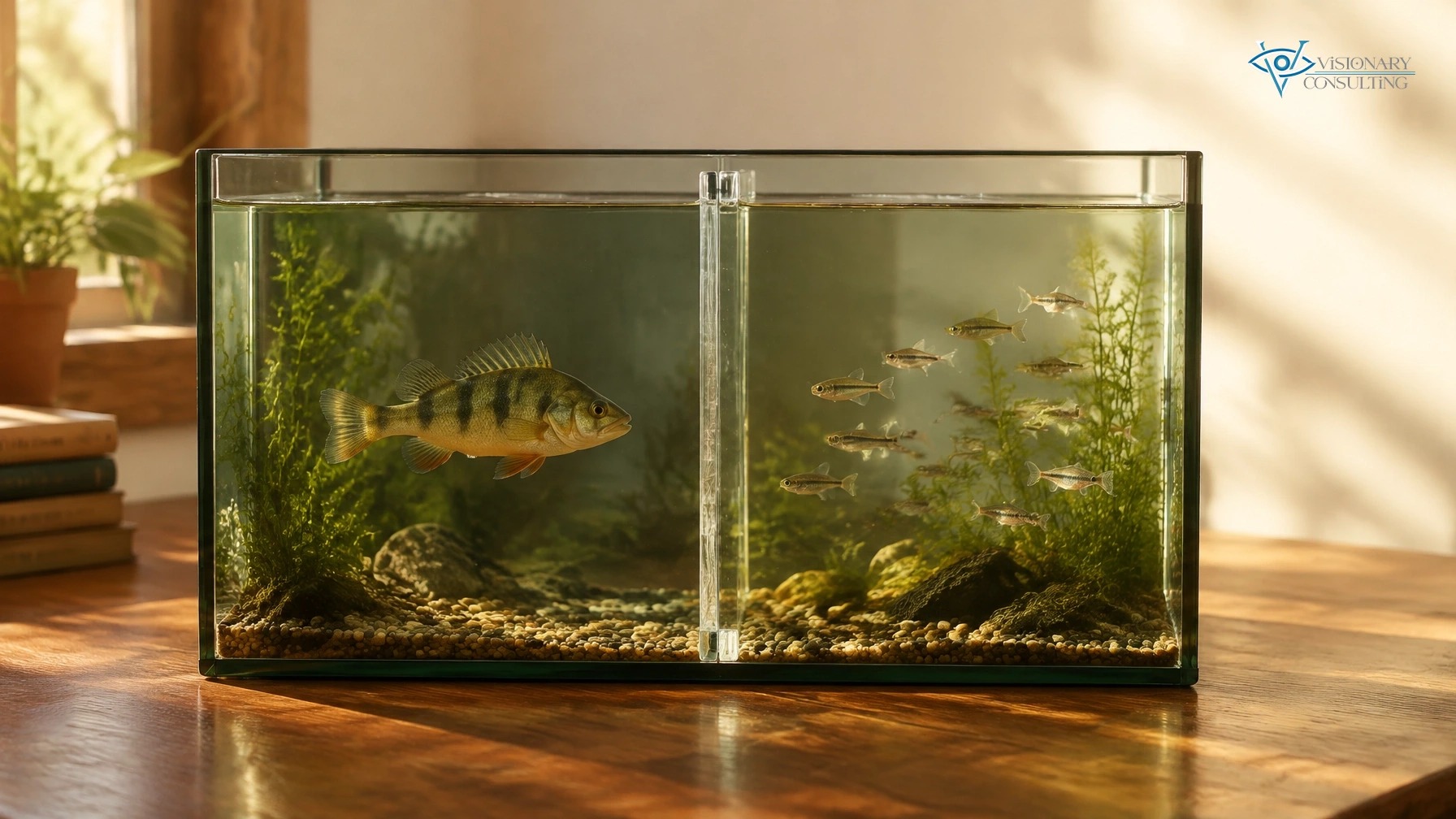
The setup was simple. Triplett put the perch in a tank with minnows, the small fish it would normally eat, and slid a clear pane of glass between them. The perch could see its dinner. It couldn't reach it. It lunged again and again, and hit the glass every time. Eventually it stopped lunging.
Then Triplett removed the glass.
The minnows swam freely around the perch, close enough to catch. And the perch largely left them alone. The barrier was gone. The lesson stayed. The tank was whole again, and the perch was still living in half of it.
Leaders aren't fish, and a crowded calendar isn't a pane of glass. But the pattern is uncomfortably familiar. After years of operating inside a constraint, the constraint moves into the body. Take it away and the body keeps turning back at the place where the wall used to be.
Signs you're still in the hallway:
- You retired a meeting and rebuilt it in direct messages.
- You moved a decision to your team and still "just take a quick look" before it goes out.
- Your team still routes everything to you, because you still answer within four minutes.
- The hours you freed up went straight back to email, and you can't name one thing you did with them on purpose.
The Hallway Is Crowded
It isn't only your habit. Your team has one too.

For years, they learned that the fastest way to a decision was you. So the week after you hand a decision to them, they still bring it to your door, not out of disrespect, but out of a route they've walked a hundred times. And when you answer, the old floor plan quietly reasserts itself. Nobody decided to undo the renovation. Everyone just kept using the old hallway.
Which means moving in can't be private. It has to be visible:
- Say out loud which decisions are no longer yours, and who owns them now.
- When the old request arrives, redirect it once, kindly, and every time after that.
- Thank people publicly for deciding without you. Whatever gets recognized gets repeated.
A renovation only works when everyone who lives in the house stops using the old door.
Two Ways to Waste a Renovation
Jennifer Brown puts the trap precisely in her new book, The Shape of Change:
"Transformation doesn't come from clinging to what was, or from rushing toward what's next. It comes from standing still."
Brown, Jennifer. The Shape of Change, 2026.
Most leaders who finish a renovation fail in one of exactly those two directions.
They cling. They keep sleeping in the hallway because the hallway is familiar. The old meeting, the old approvals, the old reachability, rebuilt quietly where nobody can see.
They rush. They fill the new room the week it opens. A new initiative, a new committee, a stretch assignment nobody needed. Week one's warning comes true: freed time isn't free. It's a vacancy, and it gets rented out by lunch.
Both feel productive. Both leave the leader exactly as full as before. Brown's third option is the one almost nobody takes, because from the outside it looks like doing nothing.
Stand Still on Purpose
There is a difference between staying still and standing still.
Staying still is habit. It's the hallway you never leave because leaving takes effort.
Standing still is a choice. It's the pause at the threshold, where you look at the new room before you decide what belongs in it.

Standing still on purpose is a discipline, and it starts small:
- Leave one block empty for two weeks. Don't fill it, don't reschedule into it. Notice what pulls at it.
- Let one question go unanswered by you. Let your team see that the decision you handed off is really theirs.
- Name what the room is for before anything moves in. If you can't say it in a sentence, the room will be furnished by whoever asks first.
October took the glass out of the tank. You traded a crowded cup for a bigger one, swapped silence for a sentence the room can act on, and redrew a floor plan built for the leader you used to be. The whole tank is open. Here's what nobody tells you about all that new water: the first thing to swim into it is rarely the thing that belongs there.
November is about building the muscle to choose what does, and the filtration to keep the water clean once you have.
Your Nine O'Clock Is Empty
Find the empty block on your calendar this week, the one the renovation created. Don't fill it yet. Sit in it once, the way Blake sat with that blinking cursor at 9:00, and notice the pull to rebuild the old room. That pull is the hallway. Naming it is how you step out of it.
Love the Locked Rooms
Perhaps building capacity is not about preparing ourselves to possess every answer. Perhaps it is about becoming able to remain with the questions: to tolerate uncertainty, to learn slowly, and to make room for what has not yet taken form.
Writing to a young poet in 1903, Rainer Maria Rilke asked him to "be patient toward all that is unsolved in your heart and try to love the questions themselves, like locked rooms and like books that are now written in a very foreign tongue."
Locked rooms. After a month of floor plans, that image lands differently. The room you built this month isn't empty because you failed to fill it. It's empty because what belongs there hasn't taken form yet.
Maybe growth begins not when we finally become enough, but when we become capable of receiving and exploring what is still emerging within us.
Unpack the Boxes
You made a new bed. Lie in it.
Next month, Capability: the muscle it takes to live in the room you built. If you're standing at the threshold and want someone to walk in with you, let's talk.
The Capacity Series
An October series on capacity: why rearranging the cup never makes it bigger, and the work that actually does.
- 01The Bigger Cup Conundrum
- 02The One Sentence Nobody at the Top Will Say Out Loud
- 03The Room Was Built for Who You Were
- 04You Made a New Bed. Now Lie In It. (you are here)
Ready to talk it through?
Book a free consultation (30 min) →